Sharing results
Links are shareable
Almost everything you select is saved in the page's URL. Copy the URL from your browser's address bar and whoever opens it sees the same commits, batches, filters and view as you. The browser's back and forward buttons also work as you'd expect.
The reference commit is written in the URL as soon as it's known (reference=<hash>). A link shared today still shows the same comparison next month, even if the reference branch moved on.
What's in the URL
On a commit page, /<project>/commit/<hash>?...:
| Parameter | What it holds |
|---|---|
path /<project>/commit/<hash> | The project and the new commit |
reference | The reference commit |
batch, batch_ref | The new and reference batches (default is CI) |
filter, filter_ref | The new and reference filters |
new_project, ref_project | Only when results come from another project |
selected_views | The view: summary, table-kpi (Metrics Table), table-compare (Metrics Diff), output-list (Visualizations), bit_accuracy (Output Files), logs, parameters (Artifacts & Configs), groups (Available Tests), tuning, optimization (Analysis) |
sort_by, sort_order | How runs are sorted |
controls | Visualizations shown or hidden, Image Diff, dynamic options (as JSON, only what you changed) |
show_all_files, expand_all, files_filter... | Options of the Output Files view (params_... for Artifacts & Configs) |
On the commit list, the Filter... box is saved as search, and the date range as from and to (e.g. ?from=2026-09-01&to=2026-09-30). On the History page, the filter, batch and chart options (selected_metric, breakdown_per_test, relative...) are saved too.
Options that have their default value are left out, to keep links short: e.g. the default batch, an empty filter, the project's default metrics and view, or visualizations shown by default. Links follow the project's defaults.
Some things stay in your browser and are not shared: your favorite projects, your private milestones, whether the controls panel is open, and the statuses of the CI jobs you started.
Copying paths, hashes and images
Results live on a shared storage, so you often want a path rather than a link:
- Commit hash: the copy icon next to the hash, in the commit list.
- Commit or batch directory: the ☰ menu of a commit row or of a commit bar, as a Windows or Linux path, or open it in the browser.
- Run output directory: the copy and folder icons on each run's card, for the new and the reference run. The folder icon opens it in the file browser, where you can copy the path of any file.
- Input path, database, batch: hover the run's name on its card and click the value to copy it.
- Configuration: hover a configuration tag, copy it as JSON, or in tuning format to paste in a tuning experiment.
- Images: the Copy button above an image viewer copies the new, reference or diff image to your clipboard, ready to paste in a chat or a slide.
Exporting files
Above the cards of the Visualizations and Output Files views, Export gathers the files matching a pattern from all the (filtered) runs, new and reference, into one directory:
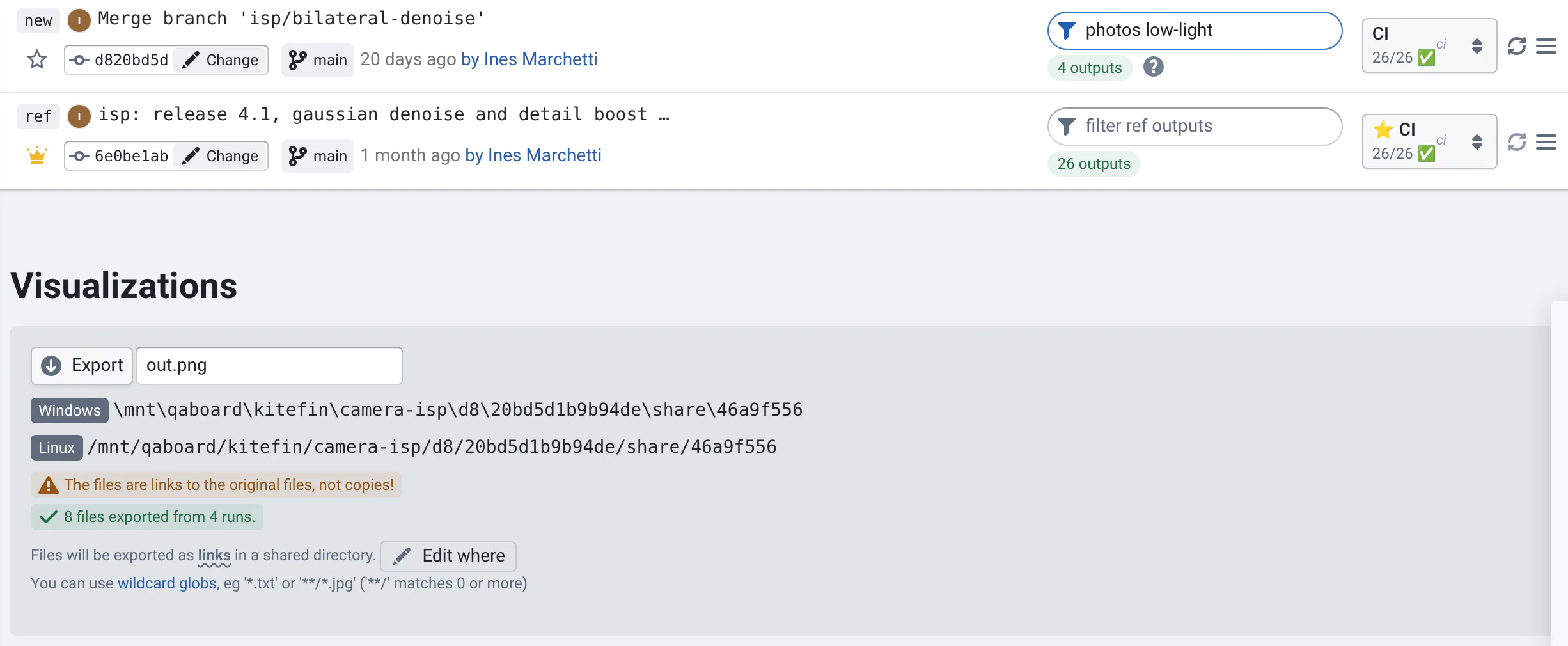
- Type a pattern, like
*.png,*.txtor**/*.jpg(**/matches any number of folders). - Click Export. The export directory's Windows path is copied to your clipboard, and both the Windows and Linux paths are shown.
- Open it to share or post-process the files, e.g. in a slide deck.
By default, files are exported as links to the original files in a shared directory (no copy, it's fast). Use Edit where to choose your own directory: files are then copied (or linked, if it's on the same filesystem).
Bug reports and support
- If the web app crashes, you'll see Sorry, something went wrong! with a Report the bug button. Depending on your server, it opens an email with the page's URL and the error filled in, or your team's issue tracker.
- For anything else, send the URL of the page you're looking at to your QA-Board admins: thanks to the URL, they'll see exactly what you see.
- Questions on how a project's results are produced (metrics, visualizations, inputs) go to that project's lead.
Admins configure where bug reports go with QABOARD_SUPPORT_URL, see Server Bringup.