QA-Board for users
This guide is for the engineers who use the QA-Board web app every day to look at results: check what a commit changed, compare it to a reference, dig into images and logs, start a few extra runs, and share what they found.
You don't need to know how the project was set up to use it.
Other audiences
- Project integration: to add QA-Board to a project (qaboard.yaml, inputs, metrics, visualizations, runners), start at Project Setup.
- Admins who run the QA-Board server: see Server Bringup and the deployment runbook.
Key concepts in plain words
| Concept | What it means for you |
|---|---|
| Project | Usually a git repository, sometimes a sub-folder of one (e.g. group/repo/sub-project). The projects list is the home page. |
| Commit | A version of the code. QA-Board shows results per commit: the commit page is where you spend most of your time. |
| Batch | A group of runs for a commit, with a label. The CI batch (label default) is shown as CI. Tuning experiments and your own local runs get their own batches. |
| Run (or output) | The code from a commit, executed on one input, with one configuration, on one platform. Each run has its output files, metrics and logs. |
| Input | What a run works on: an image, a movie, a recording, a test case... Inputs are identified by their path. |
| Configuration | The settings a run used (e.g. base, low-light), plus optional tuning parameters shown as key: value tags. |
| Metrics | Numbers computed by each run (error, speed, quality...). The project's configuration decides which ones matter, their target and whether smaller is better. |
| New vs reference | Results are always shown for a new commit compared with a reference (ref). By default the reference is the latest commit with results on the project's reference branch. |
| Milestone | A commit (and batch) bookmarked as a reference: a release, a benchmark, "the version before my refactor". Some are shared with everyone, some are private to you. |
| Artifacts | Files saved per commit, like the build output and the configuration files, so runs can be redone and configs compared. |
A map of the web app
Projects list  ─►  Commit list  ─►  Commit page  ─►  views (Summary, Metrics, Visualizations, Logs...)
     /              /<project>      /<project>/commit/<hash>
                    /<project>/commits/<branch>
                    /<project>/committer/<name>
                                    History  /<project>/history/<branch>
| Page | What it's for | Read more |
|---|---|---|
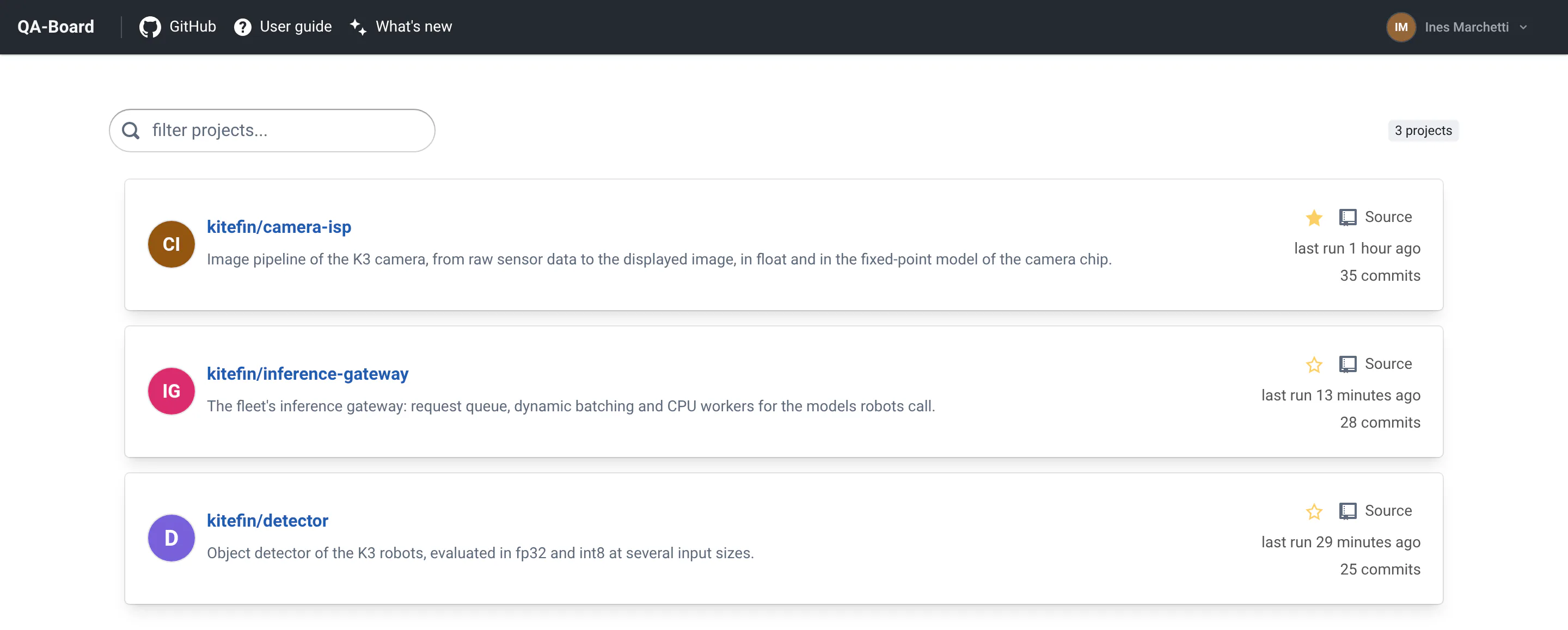
| Projects list | Find your project, pin your favorites. | Finding results |
| Commit list | The latest commits with results, per day. Filter by branch, committer, date. | Finding results |
| Commit page | Everything about one commit's results, compared to a reference. | The commit page |
| History | Metrics over time for a branch, run by run. Find which commit caused a regression. | History |
Anatomy of a page
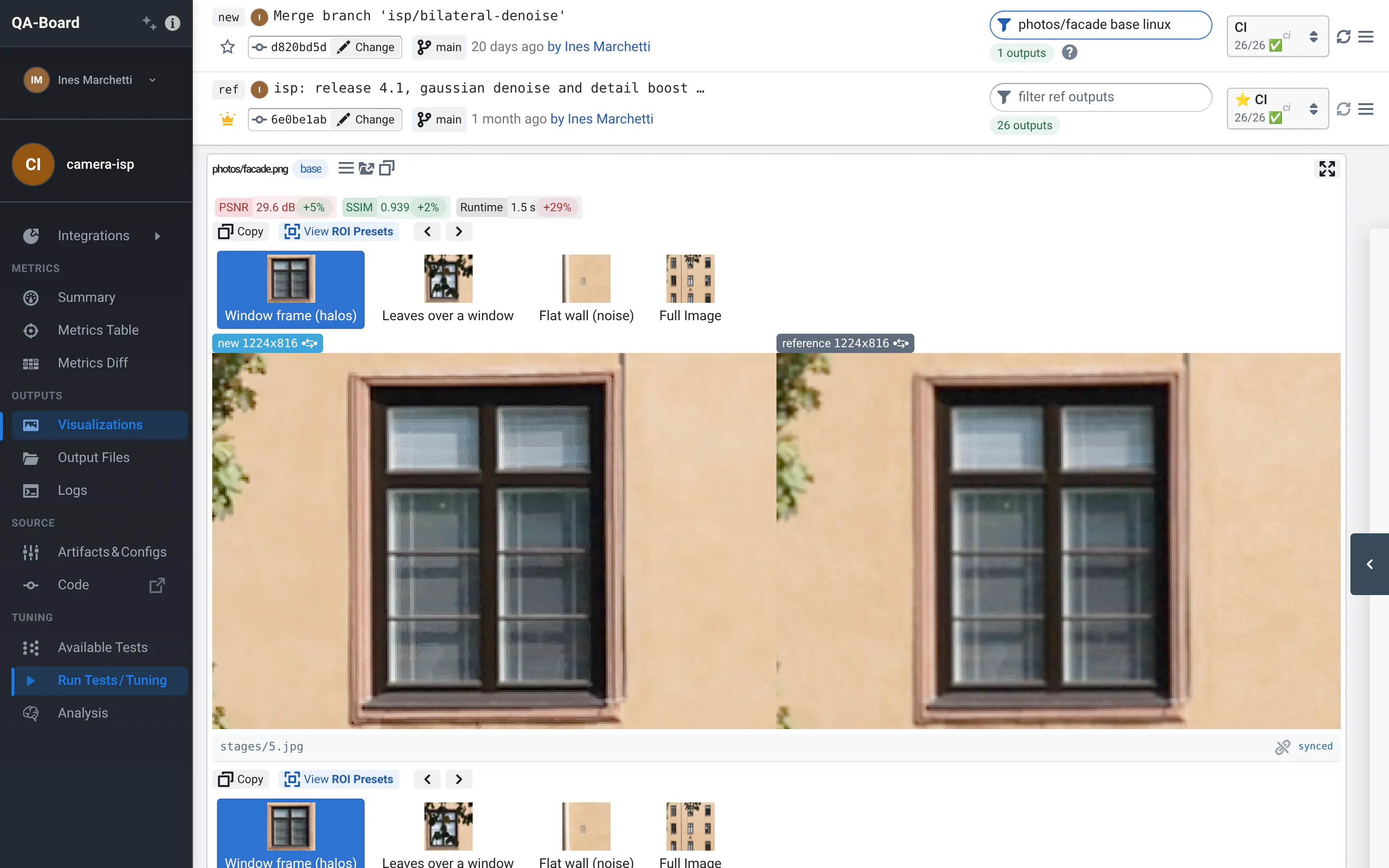
- Left sidebar:
- The QA-Board title goes back to the projects list. Next to it, the What's new button opens the release notes, and the i icon opens this guide.
- Your login, then the project's avatar: click it to go back to the project's commit list.
- Menus that depend on the page: branch, code, history, integrations and milestones on the commit list; the views of the commit page on a commit page.
- Top bar: on the commit list, the date range and a filter box. On a commit page, two bars: the new commit on top, the reference below.
- Controls panel: on the commit page, a panel on the right edge to toggle visualizations, sync options between runs, and sort runs. Click the dark tab on the right edge to show or hide it.
Where to go next
- Finding results: projects, commits, branches, batches and filters.
- The commit page: what each view is for.
- Comparing results: picking a reference, milestones, synced image viewers, colors in metric tables.
- History: metrics over time.
- Running from the web app: redo runs, start tests and tuning, trigger CI jobs.
- Sharing: links, exports and bug reports.
- Tips & FAQ: keyboard shortcuts and tricks.
- What's new: how release notes reach you.