Quality gate
qa gate and the gate: section of qaboard.yaml may change without notice: their names, defaults and output.
Tell us how it works for you in GitHub issues.
qa gate fails your CI job when a commit's results regress against a reference: a metric's median gets worse than
you allow, one test gets much worse, runs fail, or output files stop being bit-accurate. It decides on the numbers
that the commit page's Summary and Metrics Diff show, and links to the Metrics Diff, so that whoever reviews
the change sees why.
Set the rules
Add a gate: section to qaboard.yaml:
# Experimental: may change without notice
gate:
  reference: main               # a branch, a milestone or a commit. Default: project.reference_branch
  batches: [ci]                 # the batches to check. Default: the CI batch
  rules:
    - {metric: psnr, max_regression: 1%}            # the median over the runs, vs the reference
    - {metric: latency_p99, max_regression: 5%}
    - {metric: map, min: 0.42}                      # an absolute floor for the median
    - {metric: psnr, per_test_max_regression: 5%}   # no single test worse than this
  max_failed_runs: 0
  require_bit_accuracy: false
| Key | Default | Meaning |
|---|---|---|
reference | project.reference_branch | What to compare with: the label of a shared milestone, a commit's sha, or a branch. A branch means its latest commit with runs in the batch, other than the commit you check. If that commit is on the same branch, the latest one before it. |
batches | [default] | The labels of the batches to check, as qa --label sets them. The CI batch's label is default, and the web app shows it as CI: ci names it too. Each batch is compared with the reference's batch that has the same label. |
rules | none | Limits on metrics, see below. |
max_failed_runs | 0 | How many runs may fail in each batch. null doesn't check. |
require_bit_accuracy | false | Fail when a run's output files differ from its reference run's, like qa check-bit-accuracy: files that match bit_accuracy.patterns, ignoring the logs. Runs without a manifest.outputs.json make the gate undecidable. |
Rules
Each rule names a metric, and one or more limits:
| Limit | Fails when |
|---|---|
max_regression: 5% | The metric's median over the batch's runs is more than 5% worse than the reference's. |
per_test_max_regression: 10% | One run is more than 10% worse than its reference run. |
min: 0.42 | The median is under 0.42. |
max: 12 | The median is over 12. |
- Worse comes from your metrics' definitions (
outputs.metricsin qaboard.yaml, see Metrics): withsmaller_is_better: false, a smaller value is worse. Like in the web app, metrics are "smaller is better" by default. Regression rules need the metric to be declared there. - Give regressions as percentages (
5%) or fractions (0.05), relative to the magnitude of the reference's value. - Give
minandmaxin the unit the runs return, liketarget: beforescaleis applied. - Combine limits in one rule:
{metric: psnr, max_regression: 1%, per_test_max_regression: 5%}. - A metric that none of the new runs return fails its rules. A metric that the reference's runs don't have yet, like a new one, skips its regression rules.
Which numbers
The gate uses the numbers of the commit page, so that what it says is what reviewers see:
- Medians, as in the Summary: over the batch's finished runs, including failed runs that returned the metric (tuning iterations are left out), and over the reference's runs on the same inputs.
- Each test, as in the Metrics Diff: each run is compared with the reference run that matches it best (the same input, then the closest configuration and tuning parameters, then the same platform).
- The table shows each check's values, and how much worse or better they are.
Medians and per-test limits keep noisy metrics from failing the gate: one slow run moves a mean, not a median. Use
per_test_max_regression for regressions that only hurt a few inputs, which a median hides.
Run it in the CI
Run qa gate after qa batch. Its exit code fails the job. qa batch already fails when runs fail: run the gate
anyway, so that it reports them too.
- GitHub Actions
- GitLab CI
on: push

permissions:
  contents: read
  statuses: write   # for --post-status github

jobs:
  qa:
    # a runner that can write in QA-Board's results storage
    runs-on: self-hosted
    env:
      QABOARD_URL: <your-qaboard>
    steps:
      - uses: actions/checkout@v4
      - run: pip install qaboard
      - run: qa batch ci
      - run: qa gate --post-status github
        # also when runs failed
        if: ${{ !cancelled() }}
        env:
          GITHUB_TOKEN: ${{ secrets.GITHUB_TOKEN }}
<your-qaboard> is your server's URL, like http://localhost:5151. The gate also writes its table to the job's
summary. GitHub-hosted runners can't save results in QA-Board yet: see the roadmap.
stages: [test, gate]

variables:
  QABOARD_URL: <your-qaboard>

default:
  before_script:
    - pip install qaboard

qa:
  stage: test
  script:
    - qa batch ci

quality-gate:
  stage: gate
  # also when runs failed
  when: always
  script:
    - qa gate --post-status gitlab
  # optional: when the gate can't decide, warn instead of failing the pipeline
  allow_failure:
    exit_codes: 2
<your-qaboard> is your server's URL, like http://localhost:5151. To post the commit status, add a project access
token with the api scope (role Developer or more) as a masked CI/CD variable named GITLAB_ACCESS_TOKEN.
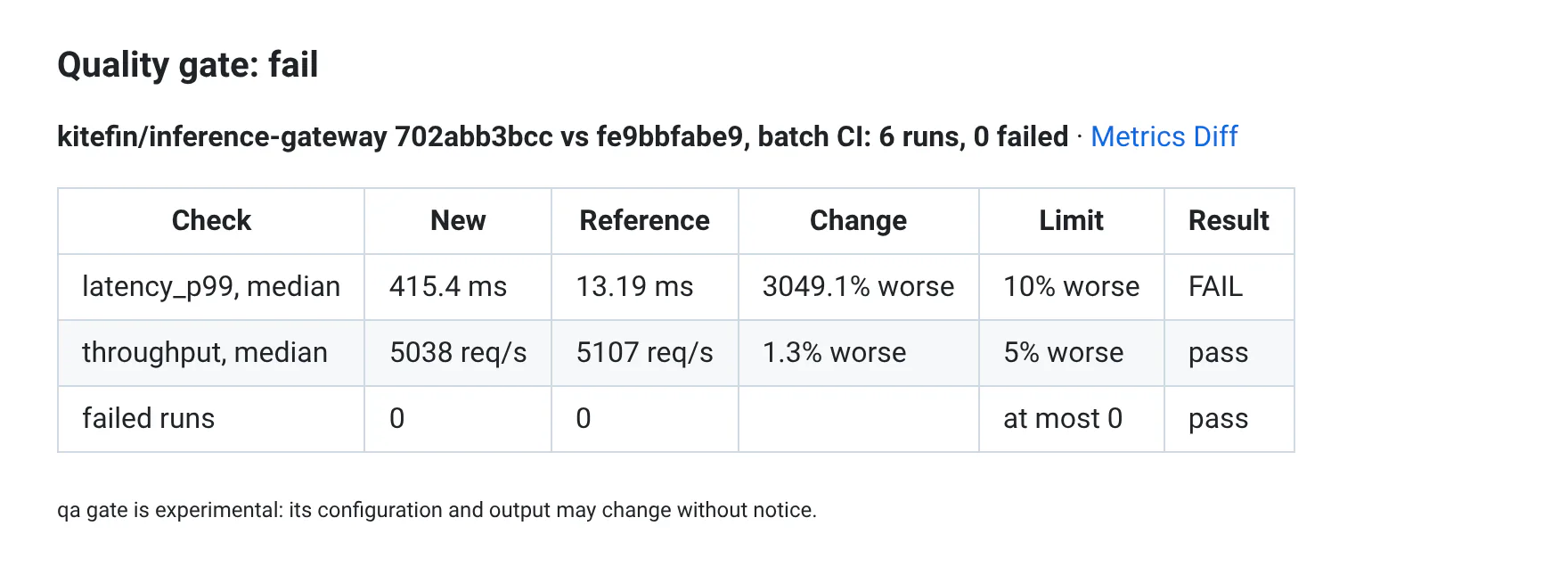
Exit codes
| Code | Verdict | When |
|---|---|---|
0 | pass | Every rule passes. |
1 | fail | A rule fails, or the gate: section has an error. |
2 | undecidable | There is no reference (or no runs to check), runs are still running, or QA-Board can't be reached. |
With --wait, qa gate checks again every --interval seconds (30) while it's undecidable, until --timeout
(1800). Use it when the reference's CI may still be running.
Commit statuses
The job's exit code already acts as a check. --post-status also posts a commit status named qaboard/gate
(qaboard/gate/<subproject> in a subproject), that links to the Metrics Diff. Require
it in your branch protection rules if you like.
- GitHub: set
GITHUB_TOKEN, and give the workflowstatuses: write.qa gatereads the repository and the API's URL fromGITHUB_REPOSITORYandGITHUB_API_URL, that GitHub Actions sets (GitHub Enterprise included). The status issuccess,failure, orerrorwhen undecidable. - GitLab: set
GITLAB_ACCESS_TOKEN. In GitLab CI,qa gateusesCI_API_V4_URLandCI_PROJECT_ID. Elsewhere it usesGITLAB_HOST(defaulthttps://gitlab.com) and the project's name from qaboard.yaml. The status issuccess, orfailed.
With on: pull_request, GitHub Actions runs on a temporary merge commit (GITHUB_SHA): qa uses the pull request's
last commit instead, for the results and the status. Check it out too, see the
GitHub Actions example. on: push is usually enough.
Options
| Option | Meaning |
|---|---|
--reference <ref> | Compare with this branch, milestone or commit instead of gate.reference. |
--batch <label>, -b | Check this batch instead of gate.batches. Repeat it for several batches. |
--commit <sha> | Check this commit instead of the current one. |
--format text|markdown|json, --json | The output: a table (default), a Markdown table, or JSON for scripts and agents. |
--wait, --timeout, --interval | Check again while undecidable, see exit codes. |
--post-status github|gitlab | Post a commit status, see commit statuses. |
--server <url> | The QA-Board server, instead of QABOARD_URL or your site's settings. |
qa gate prints a reminder that it's experimental on stderr: stdout only has the result.
From scripts and agents
qa gate --json prints the verdict, each check with its values, and the link to the Metrics Diff. The numbers come
from an HTTP API that you can use too:
curl "http://localhost:5151/api/v1/commit/<sha>/compare?project=<project>&reference=main&batch=default"
| Parameter | Default | Meaning |
|---|---|---|
project | required | The project's name, as in qaboard.yaml. |
batch | default | The batch's label. |
reference | the commit's gate.reference, else project.reference_branch | A shared milestone's label, a commit or a branch. |
reference_batch | batch | The reference's batch label, to compare two different batches. |
metrics | all | Metrics to compare, separated by commas. |
bit_accuracy | false | true compares the runs' output files. |
The answer has the status of the comparison (complete, running, or missing with messages saying why), the
commit and reference with their counts of runs, and:
metrics: for each metric, the median, the number of values and the share of runs that meet the target, for the new and the reference runs, and the change (delta,delta_relative);tests: each run, its reference run (reference_id, andreference_mismatchwhen they don't have the same input, configuration, platform or parameters), and the change of each metric.
Like the rest of the API, reading doesn't need a login unless your server restricts the project. Scripts can send an API token, see APIs.
Known limitations
- Tags can't be references yet: use the tagged commit's sha.
- A branch's commits are those QA-Board first saw on that branch. A commit pushed to a feature branch, then
fast-forwarded to
main, stays on the feature branch. - Milestones must be shared, and the gate compares the batches with the same label, whatever batch the milestone was saved on.