Run batches on an LSF cluster
With the lsf runner, qa batch sends each run to your IBM Spectrum LSF
cluster as a job (bsub), and waits for them to end. The cluster's nodes must mount your inputs and the results
storage at the same paths as the machine where you start qa batch. For other runners, see
runners.
Send your batches to LSF
-
Make
lsfthe default runner in qaboard.yaml, and give it your queue:qaboard.yamlrunners:default: lsflsf:queue: <your-queue><your-queue>is one of your cluster's queues (bqueueslists them). Withoutqueue, jobs go to the cluster's default queue. -
Run a batch.
qasends its runs as LSF jobs, then waits for them to end:qa --share batch ciQA_BATCH_VERBOSE=1also prints eachbsubcommand.
Or keep the local runner by default, and choose LSF for one command: qa batch --runner lsf ci.
Jobs get your QA-Board project's name as LSF project (-P). Every setting is optional:
runners:
  lsf:
    queue: <your-queue>     # default: the cluster's default queue ($LSB_DEFAULTQUEUE, or DEFAULT_QUEUE in lsb.params)
    # project: my/project   # default: your QA-Board project's name
    # priority: 2000        # bsub -sp. Default: 2000, or 1000 for tuning runs
    # max_threads: 8        # threads per job (0: LSF's default)
    # max_memory: 8000      # memory per job, in MB (0: LSF's default)
    # resources: "select[mem>8000]"  # bsub -R
    # options: "-W 24:00"   # other bsub options, added after all the others
Your organization's site package can set defaults for all projects, e.g. runners.default: lsf and the queue. See
Site defaults.
Limit how many run at the same time
By default all the runs from a qa batch are sent at once. To limit how many run at the same time:
runners:
  lsf:
    concurrency: 20              # 0=unlimited (default)
    # concurrency_strategy: array  # default
or qa batch --lsf-concurrency 20 my-batch. A batch can have its own concurrency (and concurrency_strategy)
under lsf:, see LSF options per batch: its runs get their own job arrays, or waves, with
their own limit. The command line option wins.
Two strategies are available:
array(default): runs with identical LSF options are sent as a single job array with a slot limit (-J "name[1-n]%20"). It's a sliding window, and a singlebsubcall. If runs need different LSF options (e.g. per input type), each group gets its own array and its own limit.waves: runs are sent by groups ofconcurrencyjobs, each group waiting for the previous one to end (-w "ended(...)"). Slow runs delay the next wave. Use it only if job arrays don't work for you.
In both cases job names keep the batch prefix, so stopping a batch from QA-Board still works.
Logs
Each run has 2 log files in its output directory:
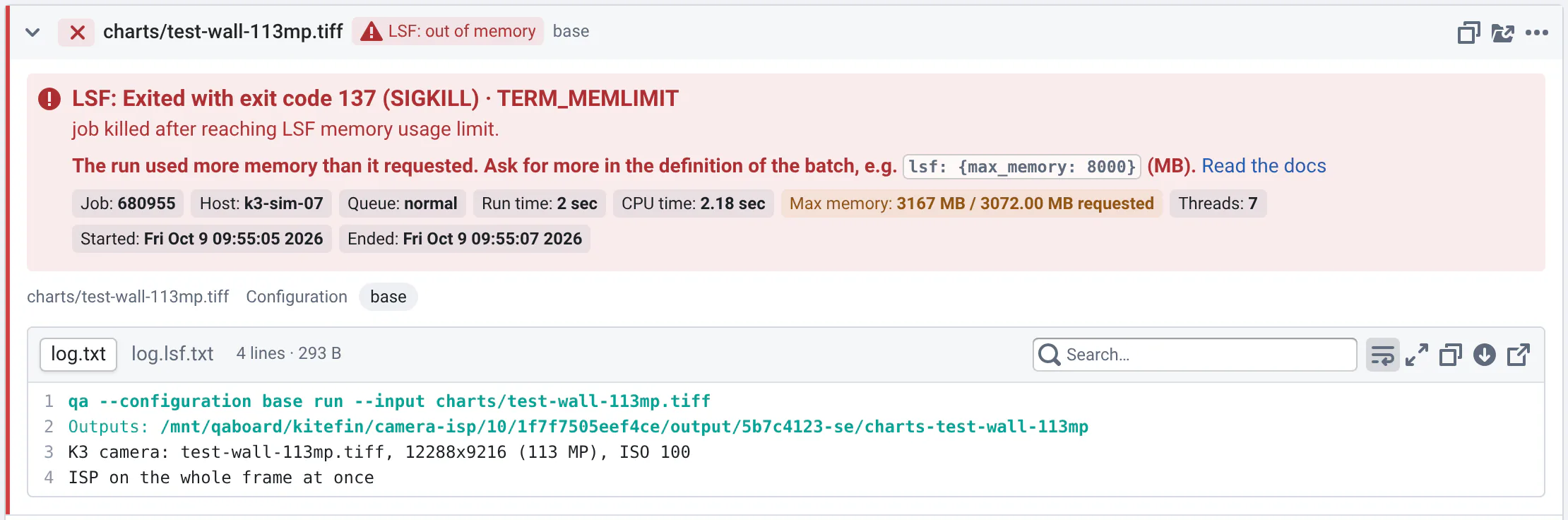
log.txt: whatqa runand your code print from Python, written live. You get it with every runner.log.lsf.txt: everything the LSF job printed, written live, including output that doesn't go through Python (subprocesses, native code, crashes). When the job ends, LSF appends its job report: exit code, why LSF terminated the job (e.g.TERM_MEMLIMIT), the host, run time, memory usage...
In the web app's Logs view:
- Failed runs get a tag explaining why LSF ended them (e.g. "LSF: out of memory"). Above the logs, a summary of LSF's job report says what to do about it, and shows the host, run time, and memory used vs requested.
- You can switch between
log.txtandlog.lsf.txt, search (Ctrl/Cmd+F, then Enter), and jump to errors. - While runs are running, logs update live. The web app only downloads what was added since the last update, and for large logs, only the end of the file at first.
With job arrays (see above), all runs share the same bsub -o file name. To get each run's job report in its own log.lsf.txt, qaboard creates symlinks to the runs' output directories in {batch_dir}/lsf/{job_array_name}/{index}, and uses -o "{batch_dir}/lsf/{job_array_name}/%I/log.lsf.txt".
Many short runs? Use a pool of workers
Each run is an LSF job, and pays LSF's scheduling overhead. If you have many short runs, run them instead on a few long-lived workers, themselves started as LSF jobs: see Dask.
Settings per batch and per input
A batch can change the LSF settings of its runs, and an input its own run's:
big-images:
  lsf:
    max_memory: 10000
    max_threads: 4
  configs: [base]
  inputs:
  - images/A.jpg
  - images/B.jpg
small-images:
  lsf:
    max_memory: 1000
  configs: [base]
  inputs:
    images/A.jpg:
    images/B.jpg:
      lsf:
        max_memory: 200
See runner settings per batch for which settings win.
On the command line
Options of qa batch override the settings of qaboard.yaml and of the batches:
qa batch --help
[...]
  --lsf-max-threads INTEGER    restrict number of lsf threads to use. 0=no
                               restriction
  --lsf-max-memory INTEGER     restrict memory (MB) to use. 0=no restriction
  --lsf-queue TEXT             LSF queue (-q)
  --lsf-resources TEXT         LSF resources restrictions (-R)
  --lsf-priority INTEGER       LSF priority (-sp)
  --lsf-options TEXT           Other LSF options (as 1 string, like '-W
                               24:00') that bsub can understand. Will be added
                               after all other CLI flags.
  --lsf-concurrency INTEGER    Max number of LSF jobs from this batch running
                               at the same time. 0=unlimited
--lsf-threads was renamed --lsf-max-threads, and --lsf-fast-queue was removed.
Send jobs through a bridge host
Where bsub isn't available, qa can send the jobs through a host that has it, e.g. from the QA-Board server, which
runs in a container, to start tuning from the web app, or from Windows. Give the
command that runs {bsub_command} there, in an environment variable:
export QA_RUNNERS_LSF_BRIDGE='ssh <lsf-host> {bsub_command}'
export QA_RUNNERS_LSF_BRIDGE='ssh <lsf-host> su {user} {bsub_command}'   # as the user who started the runs
<lsf-host> is a host that can send LSF jobs. The jobs run in the folder where you started qa batch: qa gives it
to LSF, so the bridge doesn't need to cd there.